
AI Search Optimization That Gets Your Business Named
Homeowners now ask ChatGPT and Google AI who to call. We do the work that gets your business named in those answers, and we track it month over month.
AM Creative Marketing is an AI SEO agency. We do AI search optimization, also called answer engine optimization (AEO) or generative engine optimization (GEO), for home service contractors, health and wellness practices, and other local businesses. The goal is simple: when someone asks ChatGPT, Google AI Overviews, Gemini, or Perplexity who to hire, your business gets named and described accurately.
AI assistants recommend businesses based on the same open-web signals that drive search rankings: clear business facts, real reviews, third-party mentions, and content that directly answers the questions people ask. We build those signals, then track how often a fixed set of AI questions mentions your business each month.
No one can buy or guarantee a spot in AI answers, and you should walk away from anyone who says they can. What we offer is earned visibility, measured honestly, on plans that run month to month.
The Shift
What is AI search optimization?
AI search optimization is the work of getting your business found, named, and described correctly by AI tools. That includes ChatGPT, Google AI Overviews, Gemini, Perplexity, and Microsoft Copilot. The industry also calls it AEO (answer engine optimization) or GEO (generative engine optimization). Different labels, same job.
The shift behind it is real. A homeowner who once typed "roofer near me" into Google now asks an assistant "who should I call about a leaking roof in Newburyport?" and gets back two or three business names instead of ten blue links. If your business is one of the names, you get the call. If it isn't, you never knew the customer existed.
The answers got shorter, so being one of the names got more valuable. This is the same ground our local SEO service already covers, pointed at where the answer now gets assembled.
How It Works
How do AI assistants decide which businesses to recommend?
There is no secret ranking system behind AI answers and no paid door into them. Assistants read the open web and repeat what it agrees on. Four things carry most of the weight.
A clear, consistent identity
AI has to be certain who you are before it will name you. Your business name, address, phone, services, and service area need to match everywhere they appear, character for character. Conflicting details make a machine skip you rather than risk being wrong.
Third-party consensus
Assistants trust what other people say about you more than what you say about yourself. Reviews with real detail, local press, directory listings, and mentions on sites you don't control all count as votes that you're legitimate and good at the work.
Content that answers the question
AI pulls answers in small chunks. A page that asks the customer's question plainly and answers it right underneath gets quoted. A page of vague marketing copy gets passed over, no matter how nice it looks.
Being in the data AI reads
Assistants can only cite what they can reach. If your site is slow, blocked, thin, or missing from the sources AI systems crawl, you're invisible to them regardless of how good your work is. Getting into that data is step one.
The Scoreboard
How do you know if it's working?
You should not have to take our word for it, and you should not have to learn a new dashboard to check.
Here is how we check, in plain terms. Every month we ask the same written list of questions across ChatGPT, Gemini, Google AI Mode, Perplexity, and Copilot. They are real customer questions, not keywords. Things like "who should I call about duct cleaning near Newburyport" or "best design-build remodeler on the North Shore." A short list runs a few dozen questions. A business with several services and a wide service area might carry a couple hundred.
Then we count. If the answer names the business, that question counts as a hit. The percentage in the chart below is hits divided by questions asked. A business sitting at 51% got named in about half the answers we checked that month.
Nobody sits at 100%, and you should be wary of anyone who says they can get you there. Assistants word things differently for different people, and the same question asked twice can come back with different companies. That is why we read the whole list over months instead of pointing at one good answer.
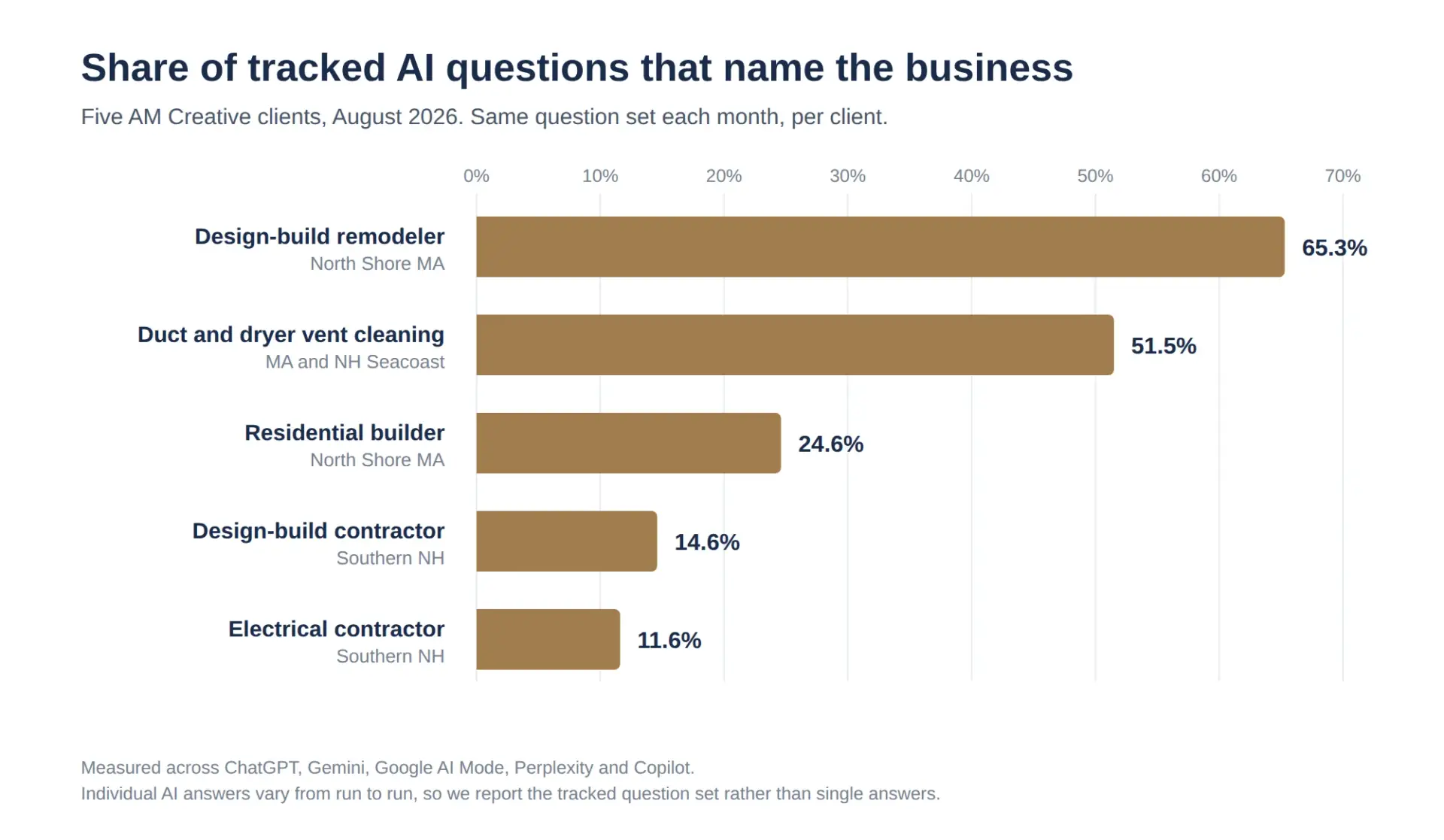
Swipe the chart to see all of it, or read the figures below.
The gap between the top and the bottom of that chart is normal, and worth understanding before you judge your own number. The businesses near the top have been at this longer, hold more reviews that mention the actual service by name, and get written about on sites they do not own. The ones lower down either started recently or work in a trade where fewer customers have thought to ask an assistant yet. Both are reasonable places to begin. What matters is which way the number moves over the next few months.
Our Process
What does the work actually look like?
Five steps, run in order. Each one feeds the next, and all of it builds assets you keep whether you stay with us or not.
Make sure AI can find you
We audit whether your site and business facts appear in the sources AI systems actually read, then fix the gaps. That means indexation, crawlability, and presence in the data aggregators and directories that feed assistant answers.
Answer the questions your customers ask
We map the real questions people put to AI about your trade and your area, then build pages that answer them directly. Service pages, FAQs, and comparison content written the way assistants retrieve it: clear question, straight answer, real detail underneath.
Build third-party proof
Reviews coached to mention the actual service, genuine local citations, and digital PR that gets your name onto sites you don't own. This is the consensus layer, and it's what separates businesses AI names from businesses AI ignores.
Keep your facts straight everywhere
We standardize your name, address, phone, hours, and service list across the web so machines describe you accurately. This is also how we reduce the risk of an assistant getting your details wrong when it does mention you.
Track it and report in plain English
We maintain a fixed set of questions your customers actually ask AI tools, and we measure how often the answers mention your business. You see the trend every month next to your calls and leads, so the work is judged on results, not activity.
Tracked Results
What can this look like in practice?
Being named in AI answers only matters if it turns into work. Here is what that looked like for one client, taken from their monthly reports rather than an estimate.
What counts as an inquiry from AI search?
When someone calls or sends a form, we ask how they found the business. If they say they asked ChatGPT, or that an assistant handed them the name, that inquiry gets recorded that way at intake. Same as Google, same as a referral, same as a truck someone spotted at a jobsite. No guessing and no modeling.
That count is almost certainly low, and we would rather tell you than let you find out later. Plenty of people hear a business name from an assistant, then open Google and search that name directly. The visit lands in the reports as Google, because that is what happened. So read the AI number as a floor rather than the full picture.
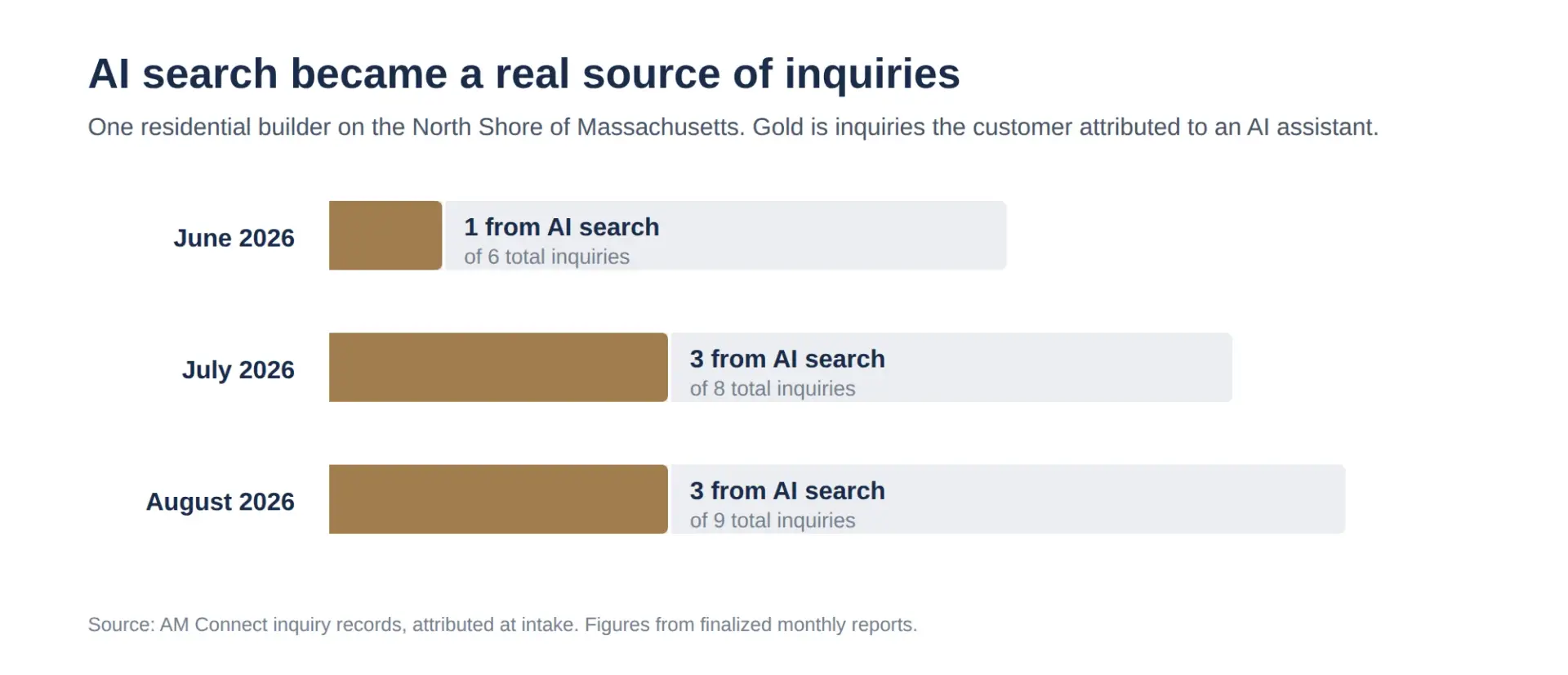
Swipe the chart to see all of it, or read the figures below.
One builder over three months is a small sample, and we are not going to pretend otherwise. Not every business starts where this one did. Some show up in none of the tracked answers at the beginning, and a newer site with a thin footprint takes longer to move. Your numbers will depend on your market, your reviews, and your starting point.
Want to know where your business sits right now?
Book a Strategy CallSide by Side
What changes when you optimize for AI answers?
The signals overlap almost completely. What changes is which ones carry the most weight, and how tightly they have to line up.
| Signal | Classic search results | AI answers | What we do about it |
|---|---|---|---|
| Your business facts | Close enough usually still ranks. | Conflicting details get you skipped. | Name, address, phone, hours and service list matched across every listing we can reach. |
| Content format | A page that covers the topic well. | A short passage that answers one question directly. | Question headings with the answer right underneath, written to be quoted. |
| Third-party mentions | Links carry most of the weight. | Agreement carries most of the weight. | Reviews that name the actual service, local press, and citations on sites you don't own. |
| Freshness | An older page can hold its spot for years. | Sources that go stale lose ground. | Content and off-site mentions refreshed on a schedule instead of published once. |
| Where you get indexed | Google. | Google feeds some assistants, Bing feeds others, and a shared crawl sits behind both. | Pages submitted to each one, not just Google. |
| How you measure it | Rankings, clicks and impressions. | How often a fixed question set names your business. | The same questions every month, reported next to your calls and booked jobs. |
None of that is a separate product. It is the same SEO program run to a tighter standard, with a measurement layer on top.
Buyer Beware
What should you avoid when buying AI search help?
This corner of marketing has attracted a wave of shortcut sellers. Google has already said publicly where this is heading, so here is what to walk away from.
"Guaranteed placement in ChatGPT" or "#1 in AI answers"
There is no door to buy. AI inclusion is earned through the same signals that earn rankings. Google's own guidance says that if someone guarantees first place, find someone else. The same logic applies to AI answers.
Tools claiming to be "Google-approved"
Google states plainly that it does not evaluate or endorse third-party SEO tools, and that none of them have access to its ranking data. Anyone claiming otherwise is telling you something Google says isn't true.
Mass-produced citations and manufactured buzz
Flooding low-quality directories or seeding fake mentions to trick AI systems is exactly the behavior search spam updates are built to catch. Gains from tricks reverse when the update lands. Gains from real authority hold.
Anyone selling AI visibility as separate from SEO
AI answers run on the same index and the same quality signals as regular search. A vendor selling you a standalone "AI trick" is either duplicating SEO work you're already paying for or doing something that won't last.
One System
Do I need this if I already do SEO?
The honest answer: good SEO already moves AI visibility, because both run on the same signals. That is exactly why we sell this as part of one system instead of a bolt-on. What AI search optimization adds is focus and measurement. Content gets shaped around the questions assistants retrieve, your business facts get tightened to the standard machines require, and your AI visibility gets tracked instead of guessed at.
In practice this work rides alongside our local SEO service, and the strongest results come when the two run together. A site built to convert matters too, since AI visibility that lands on a weak page still loses the job. That is where our web design work comes in.
One more thing worth knowing: everything we build here is yours. Content, listings, reviews, and the tracking history stay with you if you ever leave. We keep clients because the phone rings, not because a contract says so.
Who It's For
Which businesses is this built for?
Home service contractors first, and it runs the same way for health and wellness practices and other local businesses that get hired by name.
Construction and design-build marketing
Remodelers, builders and ADU contractorsHVAC marketing
Heating, cooling and indoor air qualityLocal business marketing
Trades, practices and shops that serve an areaEvery industry we serve
Electricians, plumbers, signs and moreTracked results from this work are published on our construction marketing results and HVAC marketing results pages.
FAQ
AI search questions, answered
Can you guarantee my business shows up in ChatGPT?
No, and neither can anyone else. There is no paid placement inside AI answers and no ranking data for sale. Any vendor guaranteeing a spot is selling something that doesn't exist.
What we can do is build the signals that make AI tools far more likely to name you, then show you tracked visibility data every month so you can judge the trend yourself.
Is AI search optimization different from SEO?
They overlap more than most vendors admit. AI assistants read the same web, the same reviews, and the same authority signals that search rankings use, so the foundation is shared.
The differences are in emphasis. AI retrieval favors question-and-answer content chunks, leans harder on third-party consensus, and punishes inconsistent business facts more sharply. We handle those specifics on top of the SEO foundation rather than selling them as a separate trick.
How long before AI tools start mentioning my business?
Often sooner than rankings move. AI answers reward fresh consensus and clear entity facts quickly, while classic rankings wait on link equity to mature. We've watched tracked AI visibility climb meaningfully inside two to three months while positions barely moved.
That said, your starting point matters. A business with strong reviews and a healthy site moves faster than one starting from a thin footprint. We set the baseline in month one so progress is visible either way.
How do you measure AI search visibility?
We keep a fixed set of questions that real customers ask AI tools about your trade and your service area, and we check how often the answers mention your business. Same questions every month, so the trend is apples to apples.
Individual AI answers vary from run to run, which is why we report across the whole question set rather than pointing at one lucky screenshot. When a customer tells you an AI tool sent them, we log that too.
What does AI search optimization cost?
It's included in our monthly growth plans rather than sold as a standalone line item, because the work shares a foundation with SEO and splitting them would mean paying twice for the same signals.
Current plan details are on our pricing page. Everything runs month to month, and if you ever leave, the content, listings, and improvements stay yours.
What happens to the work if I leave?
It stays with you. The content on your site, the listings we cleaned up, the reviews, the tracking history, all of it is yours from the first day. There is no license to renew and nothing to hand back.
We run month to month for the same reason. If the phone isn't ringing and we can't show you progress, you should leave, and we would rather you were able to.
Have you done this for businesses like mine?
Mostly home service contractors, plus health and wellness practices and other local businesses. You can see tracked results from this work on our construction marketing results and HVAC marketing results pages.
If your trade isn't on that list, ask on the call. The method doesn't change much between trades. What changes is which questions your customers actually put to an assistant, and researching that is where we start.
Does this matter for a small local business, or just big brands?
Arguably it matters more for local businesses. When an assistant answers "who should I call," it names two or three companies instead of showing a page of results. Being one of three is a much bigger win than being seventh of a hundred.
Local businesses also have an edge here: real reviews, a real service area, and a real reputation are exactly the third-party signals AI trusts. Most of your competitors haven't done this work yet, and early consistency is hard to catch up to.
Find out if AI tools mention your business
Fifteen minutes on the phone and we'll tell you what AI assistants currently say about your business, where the gaps are, and whether this work makes sense for you right now.
Or call us directly at (978) 464-8895