
Herniated Disc Treatment in Salisbury, MA: Effective Non-Surgical Relief with Spinal Decompression Therapy
By Jeff Newman, Newman Chiropractic
Herniated discs are a common source of debilitating back pain, affecting countless individuals in Salisbury, MA. This condition occurs when the soft material inside the intervertebral discs bulges out, often leading to nerve compression and significant discomfort. In this article, we will explore the nature of herniated discs, the mechanisms behind spinal decompression therapy, and how it can provide effective non-surgical relief. Additionally, we will discuss complementary therapies that enhance recovery, the role of chiropractic care, and share patient experiences that highlight the effectiveness of these treatments. By the end, you will have a comprehensive understanding of non-surgical options available for herniated disc treatment.
What Is a Herniated Disc and How Does It Cause Back Pain?
A herniated disc occurs when the inner gel-like core of an intervertebral disc protrudes through a tear in the outer layer, leading to potential nerve compression. This condition can result in severe pain, numbness, and weakness in the affected area. The mechanism of pain arises from the pressure exerted on nearby nerves, which can disrupt normal function and lead to chronic discomfort. Understanding this condition is crucial for effective treatment and management.
What Are the Common Symptoms of a Herniated Disc?
Common symptoms associated with a herniated disc include:
- Lower Back Pain: Often localized and can radiate to the legs.
- Sciatica: Pain that travels down the leg, typically on one side.
- Numbness and Tingling: Sensations in the legs or feet due to nerve involvement.
These symptoms can vary in intensity and may worsen with certain movements or activities.
How Does a Herniated Disc Affect the Lumbar Spine?
A herniated disc can significantly impact the lumbar spine by compressing nerves that exit the spinal column. This compression can lead to mobility issues, making it difficult for individuals to perform daily activities. Pain during movement is common, and the affected person may experience stiffness and reduced range of motion. Understanding these effects is essential for developing an effective treatment plan.
Spontaneous Resorption of Lumbar Disc Herniation with Non-Surgical Management
1. Spontaneous resorption of lumbar disk herniation (LDH) presents a promising avenue for the non-surgical management of herniated disks. Here we present a 40-year-old female with severe L5/S1 herniation who experienced spontaneous resorption confirmed by MRI. The patient adhered to a comprehensive non-operative treatment regimen comprising NSAIDs, heat therapy, massage therapy, acupuncture, and kinesitherapy. Over two years, the patient showed substantial clinical improvement, with significant pain reduction and MRI evidence of disk resorption, resulting in a marked decrease in their visual analog scale (VAS) pain scores. Through a systematic review of existing literature, we identify that spontaneous resorption is associated with mechanisms such as inflammation, neovascularization, macrophage infiltration, matrix degradation, disruption of immune privilege, apoptosis and autophagy, and disc dehydration. Clinical predictors for spontaneous resorption of LDH include the size, type and composition of the herniation, rim enhancement on contrast-enhanced MRI, and involvement of the posterior longitudinal ligament (PLL). Future research should focus on elucidating the molecular mechanisms of resorption, regulation of inflammatory response, macrophage polarization, matrix degradation, immune privilege and neovascularization, developing advanced imaging techniques to predict resorption potential, and exploring personalized treatment strategies based on machine learning and deep learning prediction models.
Mechanisms and management of self-resolving lumbar disc herniation: bridging molecular pathways to non-surgical clinical success, 2025
How Does Spinal Decompression Therapy Provide Non-Surgical Relief?
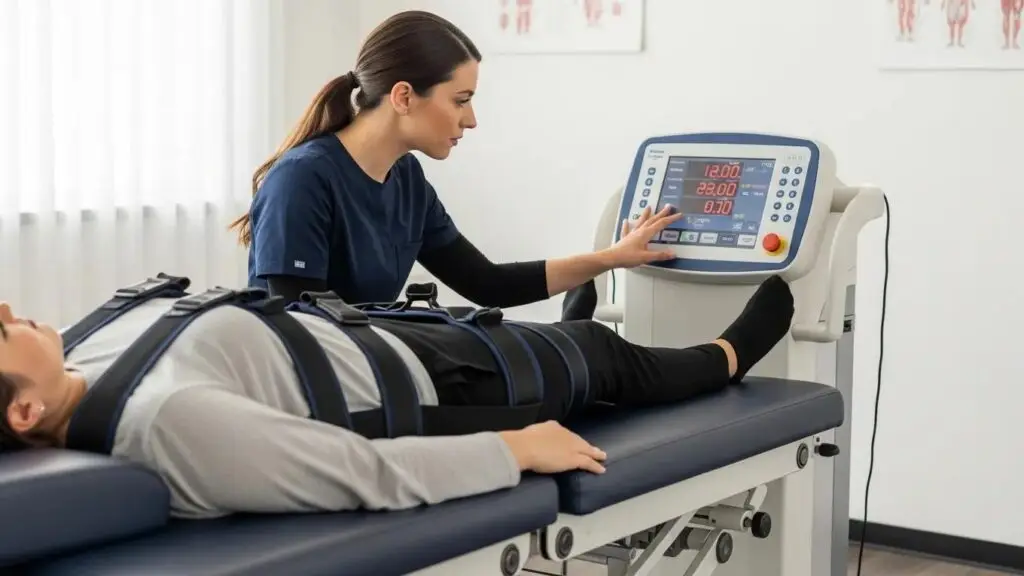
Spinal decompression therapy is a non-surgical treatment designed to relieve pressure on the spinal discs and nerves. This therapy works by gently stretching the spine, creating negative pressure within the discs, which can help retract the herniated material and alleviate pain. The procedure is typically performed using a specialized table that allows for controlled traction.
What Is the Procedure and Mechanism of Spinal Decompression Therapy?
The procedure involves the following steps:
- Setup Process: The patient lies on a decompression table, and harnesses are applied to the pelvis and trunk.
- Traction Application: The table gently stretches the spine, creating space between the vertebrae.
- Nerve Relief: This process helps to relieve pressure on the nerves, promoting healing and reducing pain.
The mechanism behind this therapy is based on the principle of creating negative pressure, which can facilitate the retraction of herniated disc material.
Non-Surgical Spinal Decompression for Lumbar Radiculopathy
1. Lumbar radiculopathy is an extensively common complaint reported by patients of low back pain (LBP), resulting in several impairments. A comparatively novel technique, non-surgical spinal decompression (NSD), is introduced, which uses a sensitive computerized feedback mechanism and decompresses the spinal nerve roots through segmental distraction. The objective of this study was to determine the effects of NSD therapy in addition to routine physical therapy on pain, lumbar range of motion (ROM), functional disability, back muscle endurance (BME), and quality of life (QOL) in patients with lumbar radiculopathy.
Effects of non-surgical decompression therapy in addition to routine physical therapy on pain, range of motion, endurance, functional disability and quality of life …, F Amjad, 2022
Lumbar Traction Effectiveness on Herniated Disc Size and Symptoms
1. We investigated the effects of continuous lumbar traction in patients with lumbar disc herniation on clinical findings, and size of the herniated disc measured by computed tomography (CT). In this prospective, randomized, controlled study, 46 patients with lumbar disc herniation were included, and randomized into two groups as the traction group (24 patients), and the control group (22 patients). The traction group was given a physical therapy program and continuous lumbar traction. The control group was given the same physical therapy program without traction, for the same duration of time. Data for the clinical symptoms and signs were collected before and after the treatment together with calculation of a herniation index, from the CT images that showed the size of the herniated disc material. In the traction group, most of the clinical findings significantly improved with treatment. Size of the herniated disc material in CT decreased significantly only in the traction group. In the traction group the herniation index decreased from 276.6±129.6 to 212.5±84.3 with treatment (p<0.01). In the control group, pretreatment value was 293.4±112.1, and it decreased to 285.4±115.4 after the treatment (p>0.05). Patients with greater herniations tended to respond better to traction. In conclusion, lumbar traction is both effective in improving symptoms and clinical findings in patients with lumbar disc herniation and also in decreasing the size of the herniated disc material as measured by CT.
Effect of continuous lumbar traction on the size of herniated disc material in lumbar disc herniation, OH Gunduz, 2006
What Are the Benefits and Risks of Spinal Decompression Therapy?
Spinal decompression therapy offers several benefits, including:
- Reduced Pain: Many patients experience significant pain relief after treatment.
- Improved Mobility: Enhanced range of motion and reduced stiffness.
- Non-Invasive: As a non-surgical option, it avoids the risks associated with surgery.
However, potential risks may include temporary discomfort or exacerbation of symptoms. It is essential to consult with a healthcare provider to determine if this therapy is appropriate for individual conditions.
What Complementary Therapies Enhance Herniated Disc Recovery?
In addition to spinal decompression therapy, several complementary therapies can enhance recovery from a herniated disc. These therapies work synergistically to improve healing and alleviate pain. For those seeking comprehensive care, exploring the services offered at chiropractic services can be beneficial.
How Does Laser Therapy Aid Tissue Healing and Pain Reduction?
Laser therapy utilizes focused light to stimulate tissue healing and reduce inflammation. The mechanism involves increasing blood flow to the affected area, promoting cellular repair and regeneration. Benefits of laser therapy include:
- Accelerated Healing: Enhances recovery time for damaged tissues.
- Pain Reduction: Reduces inflammation and discomfort in the affected area.
- Non-Invasive: Provides a safe alternative to more invasive treatments.
What Is Focused Shockwave Therapy and Its Role in Back Pain Relief?
Focused shockwave therapy involves the application of acoustic waves to the affected area, promoting healing and pain relief. This therapy works by stimulating blood flow and cellular repair. Key benefits include:
- Pain Relief: Effective in reducing chronic pain associated with herniated discs.
- Tissue Regeneration: Encourages the healing of damaged tissues.
- Quick Recovery: Patients often experience rapid improvements in symptoms.
Discover more about focused shockwave therapy and its applications in pain management.
How Does Chiropractic Care Support Non-Surgical Back Pain Relief in Salisbury?
Chiropractic care plays a vital role in the non-surgical treatment of back pain, particularly for those suffering from herniated discs. Chiropractors utilize various techniques to align the spine and improve overall function. To learn more about the approach and philosophy of chiropractic care, visit the about us page.
How Does Chiropractic Care Integrate with Spinal Decompression Therapy?
Chiropractic care can complement spinal decompression therapy by addressing misalignments and enhancing spinal health. Benefits of this integration include:
- Holistic Approach: Treats the underlying causes of pain, not just the symptoms.
- Enhanced Results: Patients often experience better outcomes when combining therapies.
- Personalized Care: Chiropractors tailor treatment plans to individual needs.
What Are Patient Experiences and Success Stories with Non-Surgical Treatments?

Patient experiences provide valuable insights into the effectiveness of non-surgical treatments for herniated discs. Many individuals report significant improvements in their quality of life after undergoing spinal decompression therapy and complementary treatments.
How Have Patients in Salisbury Benefited from Spinal Decompression Therapy?
Patients in Salisbury have shared positive testimonials regarding their experiences with spinal decompression therapy. Common benefits reported include:
- Improvement in Symptoms: Many patients experience reduced pain and increased mobility.
- Quality of Life Changes: Enhanced ability to perform daily activities without discomfort.
- Patient Satisfaction: High levels of satisfaction with non-surgical treatment options.
What Do Recent Clinical Studies Reveal About Treatment Effectiveness?
Recent clinical studies indicate that non-surgical treatments, including spinal decompression therapy, are effective in managing herniated disc symptoms. Key findings include:
- Effectiveness of Treatments: Studies show significant pain reduction and improved function in patients.
- Statistical Outcomes: Many patients report a marked decrease in pain levels after treatment.
- Recommendations for Patients: Healthcare providers often recommend these therapies as first-line options for managing herniated discs.
What Are Common Questions About Herniated Disc Treatment and Recovery?
Understanding the treatment and recovery process for herniated discs can alleviate concerns for patients considering non-surgical options.
How Long Does Recovery Take Without Surgery?
Recovery from a herniated disc without surgery typically takes between 8-12 weeks, depending on the severity of the condition and adherence to treatment protocols. Factors affecting recovery include:
- Individual Health: Overall health and lifestyle can influence healing times.
- Treatment Compliance: Following prescribed therapies and recommendations is crucial.
- Severity of Condition: More severe cases may require longer recovery periods.
What Are Alternative Non-Surgical Treatments for Herniated Discs?
Several alternative non-surgical treatments are available for herniated discs, including:
- Physical Therapy: Focuses on strengthening and stabilizing the spine.
- Acupuncture: May help alleviate pain and improve function.
- Medication: Non-steroidal anti-inflammatory drugs (NSAIDs) can provide temporary relief.
These alternatives can be effective in managing symptoms and promoting recovery. For comprehensive care options, consider visiting Newman Chiropractic.